

At Mothapalooza, Community Members Explored the Vital Role of Nocturnal Pollinators through Hands-On Learning, Expert Presentations, and an Unforgettable Evening Under the Stars
Written by Cottonwood Institute Instructor and & Social Media Coordinator Harmony Esqueda. At dusk on a warm summer night, a crowd eagerly gathered at Beech Open Space near Longmont for an evening of moth watching, stargazing, and educational presentations to learn more about nocturnal pollinators at Mothapalooza.
In attendance were several organizations that came together to present and offer educational resources, such as The University of Colorado Museum of Natural History, which brought bug collections including butterflies, moths, caterpillars, and more for folks to interact with under the microscope.
 Also in attendance was DarkSky Colorado, an organization that raises awareness of the effects of light pollution and offers advice on how to limit it to help the environment and improve visibility of the stars. Richard O’Brien, a volunteer representing DarkSky Colorado, has been advocating for nocturnal pollinators for years,
Emily Kencairn, representing People and Pollinators Action Network, generously offered native plants and wildflower seeds to everyone in attendance. The organization also provided resources related to pollinators and the dangers of neonicotinoids – which are among the most widely used insecticides in crop protection and are absorbed into plants, affecting leaves, flowers, nectar, and pollen, negatively impacting endangered species, critical habitats, and pollinators.
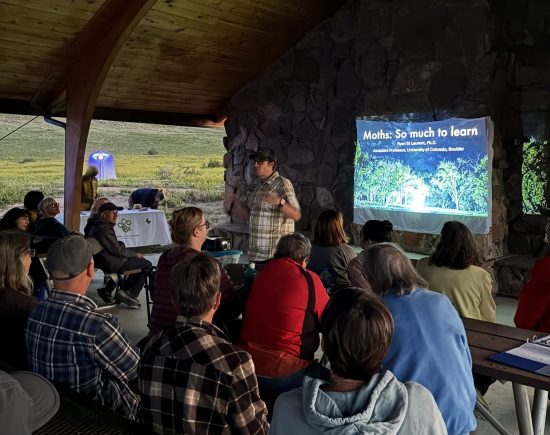
Dr. Ryan St. Laurent, an evolutionary biologist and Assistant Professor at CU Boulder and a CU Museum Curator of Entomology presented on the importance of moths.
 There are over 140,000 species of butterflies and moths, and 90% of those are moths. In Colorado we have over 3,000 species. All butterflies are moths but not all moths are butterflies, so if you’re interested in butterflies and moths, it’s actually worth studying moths as a whole. What’s really surprising to a lot of people about moths is that most of them are pollinators, and there are more species of moths that pollinate than butterflies and bees combined. This is a huge section of pollination that we know very little about.
Dr. St. Laurent encouraged folks to reduce light pollution by turning off unnecessary lights at night so as not to disorient and harm moth populations. He also encouraged everyone to put on their community scientist hat and document moths on iNaturalist, which will not necessarily be helpful in identifying the moth species, but it does help researchers.
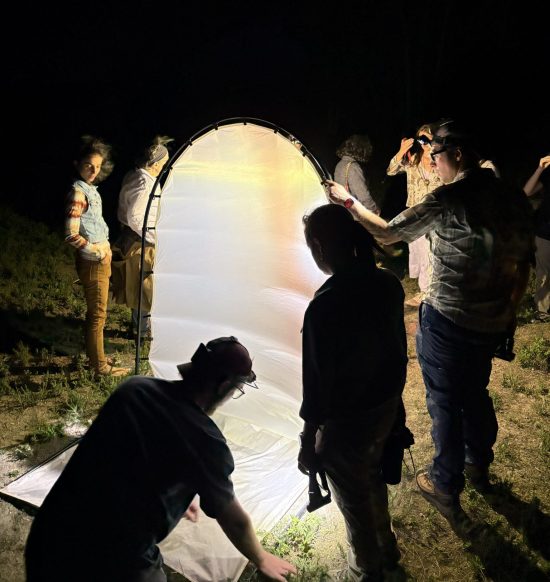
Once the sun set, we made our way over to various moth traps to observe the moths. White pop-up tents were lit up by LED lights that emit a certain spectrum of light to attract the moths. To our human eyes, the pretty blue, purple, and green lights were certainly eye-catching. A different trap used a mercury vapor light, and another trap used a method of releasing pheromones to catch moths in a bucket.
We had the opportunity to observe moths of all different shapes and sizes at each station, which was an incredible sight and a great way to close out a very successful Mothapalooza!
Thank you DarkSky Colorado, People and Pollinators Action Network, and the University of Colorado Museum of Natural History for collaborating with Cottonwood Institute to make Mothapalooza possible.
If you’re also passionate about helping students get outdoors to learn about the natural world and take action to make change in their communities, please consider making a donation or becoming a monthly donor! You’ll help invest in our students, programs, and long-term sustainability and success!
