Grafitti, Local Food, and Night Hikes: Strive Prep Makes Lasting Memories With Cottonwood Institute
May 16, 2013 by Madeline Bachner
Filed under STRIVE Prep
STRIVE Preparatory Schools recently wrapped up two of our “Mini-CAP” 6-week Community Adventure Programs. The Westwood campus and the Lake campus both had a great time during their 6-weeks together, which concluded with a final overnight camping trip. During the accelerated version of our Community Adventure Program, the students played games, learned more about each other, gained knowledge about local environmental issues, and created two Action Projects to address them as a group.
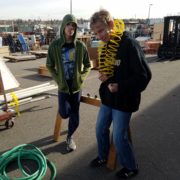
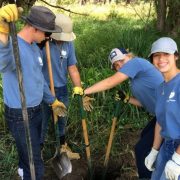
Westwood campus decided to work on the environmental impact of graffiti. They were confronted with graffiti in their neighborhoods every day, wanted to learn more, and wanted to do something about it. The group spoke to Denver Parks and Recreation and clean-up professionals to learn more about the process of how graffiti is eliminated. They then choose to do a little cleaning up themselves and spent an afternoon covering graffiti in their neighborhood.
Lake campus elected to learn more about local food and revitalize a garden at school. The group dove into the idea of growing food yourself and after securing supplies, tidied up an existing garden at school and got it ready for the spring growing season.
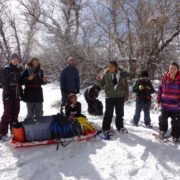
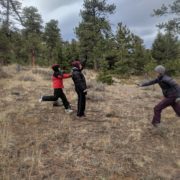
Students had been looking forward to the overnight camping trip for six weeks, which most students shared was their favorite part of the course. Both campuses were able to join together to create a fun filled weekend and make some new friends! The weather was a little chilly but they had a great time anyway, exploring Cal-Wood and learning the basics of low impact camping. One often mentioned highlight was a hike to the Mica Mine at Cal-wood. On the way there the group spotted a bunch of old bones and had fun reconstructing creatures, both real and imaginary. The mine itself is an old dig into the hillside where mica was extracted. The area and the hole in the hill glitter with the left-over mica and at night it is quite an experience…especially with a night hike for the return trip!
Thanks to STRIVE Preparatory Schools, their enthusiastic teachers, our amazing Cottonwood Institute instructors, and Cal-Wood for hosting us. Our programs with Strive would not be possible without our donors and supporters, including Avnet Technology Solutions, New Belgium Brewing Company, and The Kenneth King Foundation.
Snow Flies as Casa de la Esperanza Gears up for Mini-CAP!
April 17, 2013 by Madeline Bachner
Filed under Casa de la Esperanza
Cottonwood Institute is starting another season of our 6-week Community Adventure Program with Casa de la Esperanza in Longmont, CO. It’s been a rough start with school canceled due to snow and cold blustery days keeping many activities indoors. Despite the weather, we have a dedicated group of students getting to know each other and starting to learn about environmental issues.
The first class was a great introduction both to the new students and to the world around them and the idea of environmental issues. Now after a second session, the students are getting acquainted with the importance of local environmental issues,
from plastic bottle waste, to climate change, finding local food and recycling. They spent the class learning about local issues and have the task of bringing back information on one they are interested in next week when they will pick their issue and start in-depth research on their topic.
After completing their project in mid-May, the group will go on an overnight camping trip to explore the outdoors further and celebrate what they have accomplished! This weekend at Cal-Wood Education Center will be their culminating experience with Cottonwood Institute. We hope the weather is a little warmer for them by then!
A special thanks goes out to our supporters, including: Community Foundation Serving Boulder County and The North Face Explore Fund!
CAP Update: Inspiration from People and Places
February 5, 2013 by Katie Craig
Filed under Community Adventure Program, Notes From The Field
We’ve had an exciting quarter in CAP so far, filled with hikes, camping, and guest speakers. During the first two weeks of the quarter, we spent many classes navigating miles of trails that traverse the hills just minutes from New Vista High School at Boulder Mountain Park. While learning ecology, minimum impact hiking, and sensory awareness skills, we began to understand our role in the natural world. What’s your connection to the environment?
Here are some reflections from a few students our class:
There’s something really spiritual about the wilderness for me. In my life I have to be involved and a part of so many things. The wilderness gives me a chance to spectate and appreciate the beauty in life where so often I focus on the negative…Even the smog about Denver looks magnificent when it’s hit by the beams of a setting sun. – Harper
The experience: Breathtaking, Astonishing, Fresh. I love the experience and the quality time I’m spending with my peers. – Carter
I enjoy hiking because it gives me peace of mind. The reason why it gives me peace of mind is because it lets me get away, that these problems I had before I was hiking don’t matter right now. The only thing that matters right now is where I’m going. It’s like entering a new world where it’s not rush, rush, rush. It’s just take your time and go at your own pace. – Thomas
All of our class experiences in the natural world certainly give us a reason to want to protect the environment. As we dive into understanding some of the issues that threaten the Boulder ecosystem, we invited two guest speakers to our class. Katie, from Eco-Cycle, taught us how we can move towards zero-waste on the individual, school, and community levels. Betty, from Boulder Open Space and Mountain Parks, taught us about a few of the urban wildlife conflicts that affect us in Boulder. It was a fun and interactive program; we held furs and footprint molds, looked at different types of scat, and listened to animal calls. We were so inspired by the presentation, we decided to research the topic more and form an Action Project on Boulder’s urban wildlife conflicts. We’re just beginning our research this week, but we’ll keep you updated as we learn, play, and experience more throughout the quarter.
Take a look at pictures from our overnight camping trip at Cal-Wood on CAP’s Photo Site.
Alumni Update: Brian Fauver
January 3, 2013 by Katie Craig
Filed under Cottonwood Institute News
Are you a Cottonwood alumnus? We’d love to hear from you! What are you up to? Email Us!
We recently had the opportunity to reconnect with Brian Fauver, a Cottonwood Institute alumnus. Even as he enters a graduate degree program, he continues to use the problem-solving, critical thinking, and leadership skills he gained through CAP. Keep reading to learn how CI continues to impact Brian as a student, professional, and outdoor-connoisseur.
I am working two seasonal jobs: the first at the Denver Zoo, which is during the summer and fall. I help out with the Front Range Pika Project, which is a Citizen-Science project. The organization trains volunteers to collect data on pika habitat over time. I also work at the Natural Resource Ecology Lab at CSU, where I will be pursuing a graduate degree in the fall. My work there is about Citizen-Science, or Public Participation in Scientific Research/Community Based Monitoring. More specifically, I research the cultural differences in effectively managing a successful Citizen-Science program.
What do you remember most about your Cottonwood Institute (CI) experience?
I remember being a part of the CI community. After taking three CAP courses at New Vista High School in Boulder, I soon became at CI intern. While an intern, I went as a student on an Instructor Training overnight. I enjoyed looking at the organization from the several different perspectives: as a student, and as someone giving feedback.
What are the coolest skills you’ve learned from CI that you’ve been showing your friends or family?
Winter camping. Quinzees. And of course, friction fires.
How has your CI experience helped you create positive change in your community?
Before I took CAP, I wanted to help out with environmental conservation. I had interned at both the Sierra Club and The Nature Conservancy. I couldn’t help feeling overwhelmed with my inability to change large national/regional scale problems. Taking CAP helped introduce me to the idea of local change and community organizing. This seemed like a much more attainable model.
Based on your CI experience, what piece of advice would you like to give to other students?
Since I took three different CAP courses, looking back, it is evident how much more effective the action projects that were group-inspired (rather than individually-inspired) were.
Try not to be too ambitious. Think big, but enact small tangible changes.
Thanks Brian!
Edited by Katie Craig
Top 10 Inspiring Stories From 2012
December 20, 2012 by Ford Church
Filed under Cottonwood Institute News
We are wrapping up another incredible programming year with the Cottonwood Institute and have been blown away by the students we have served and the Action Projects they have taken on to improve their schools, the community, and the environment.
In 2012, we served over 375 youth, logged over 15,000 program contact hours, and recorded over 6,500 service-learning project hours “changing the world, one adventure at a time!”
So what were our students actually up to you ask? Here is a list of our Top 10 Inspiring Stories from 2012:
10. Together We Can Change The World: Earth Task Force and Cottonwood Institute Present at National Green School Conference
9. Takeaways From The 2nd Annual Johnson & Wales Environmental Leadership Summit
8. Lakewood High School Students Change Their World
7. Life Lessons: Making Connections On CAP Overnights
6. Wandering In Nature With Buckley Air Force Base Youth
5. The Three C’s: Casa, Calwood, and Camping!
4. Veggies Bring Out The Best In Us: CYC Youth Take On Farming!
3. Earth Task Force Digs Into The New Vista Garden Project
2. Music Survival Project: Inspiration From The Woods
1. Exploration and Transformation for STRIVE Prep Students
We can’t inspire our students without the generous support of our educational partners, students, parents, staff, instructors, board members, donors, corporate sponsors, and foundations.
Please consider making a tax-deductible donation before December 31, 2012 to help make sure we have the resources to continue to deliver amazing programs in 2013 by Clicking Here.
Happy Holidays from the Cottonwood Institute!
Life Lessons: Making Connections on CAP Overnights
December 12, 2012 by Katie Craig
Filed under Community Adventure Program
After two overnight camping trips, Community Adventure Program students reflected on their experiences thus far. Many students made deep connections between our class and everyday life. Read what Lucy had to say about her CAP class wilderness experiences:
I got many things out of the two overnights that we went on as a CAP class. One of the main things I got out of the trips was new friends. When you are spending a lot of time close to the same people, you really get to know them, especially when you depend on them for food, water, and shelter. Especially by the end of the second trip, I was very comfortable spending time with my classmates, and I think now our whole class has a new dynamic. Something else that I took from these trips was a new perspective on how I live. I realized that I don’t spend enough time just by myself to think, and I also spend too much time depending on electronics and communication. After these trips, I will try to live more simply and not depend so much on electronic entertainment. I will also try to save some time for myself to just be outdoors and think.
One of the memorable things that I learned on our overnights was how to make a one match fire or a fire with flint and steel. On the first trip I learned how hard it is to make a fire in the first place, and on the second trip I learned that you can do it with one match and patience. Something that goes with this is that I learned how important it is not to become frustrated with bad results. The first time, we tried to make a fire for about an hour, and in that time we did not communicate as a group and we became very frustrated. However, the second time when we were much more patient and communicative, we started the fire quickly and easily. This is a lesson that is not only important for camping but also for life in general.
Something else that I noticed was that in nature, our senses seem to pick up and become much sharper. During my sit spot, I observed my surroundings with great detail. I was in a very good spot so that I could also hear echoes, and I even heard flapping wings of two birds over my head. I would never be able to hear something like this in civilization or even if I was around other people at the time. An example of how my sight improved was with the stars. In the wilderness, you can always see stars better because there are no city lights to interrupt them. I really appreciated the stars more when I could see them better, because I knew they wouldn’t be the same when we got back home.
I really enjoyed all parts of the trips, but there are several memorable highlights that stood out to me. On the first trip, my main highlight was when we reached the top of our hike and saw the amazing view. I really liked this because after a tiring hike, it was nice to sit and enjoy it for awhile and it felt like we had reached a goal. On the second trip, my highlight was probably the sit spot because we were in such an amazing and peaceful place. Those events are probably the things I will remember most about the trips, but I enjoyed every part of them. Overall, I thought these trips were an amazing and new learning experience and they were one of the best parts of my quarter. Now, I have a better understanding and appreciation for the environment that I will carry for the rest of my life.
Check out more pictures of our adventures by Clicking Here!
Written by Lucy Briggs, edited by Katie Craig.
Cottonwood Institute Welcomes New Adventure Coordinator
September 28, 2012 by Ford Church
Filed under Cottonwood Institute News
It’s a dirty job, but someone has to do it. That someone is Katie Craig and she has hit the ground running! The Cottonwood Institute has been going through a fall transition of our own as we welcome Katie Craig as our new Adventure Coordinator and Community Adventure Program (CAP) Instructor at New Vista High School.
Katie brings a passion for adventure, community, and the environment to the Cottonwood Institute. While earning a B.A. in Government and Environmental Studies at St. Lawrence University, she explored a variety of experiential education models as a student, teacher, and guide. She weaves an artistic imagination and a love of the wild into all of her teaching. Katie has worked nationally and internationally for many outdoor and environmental education organizations, including the National Outdoor Leadership School (NOLS), the Women’s Wilderness Institute, and the Appalachian Mountain Club. She spends her free time playing with the beautiful Juniper-dog, rock climbing, dropping knees, fermenting food, and practicing shavasana.

With our programming dream team back in place, we are excited to create some amazing adventures for schools and youth organizations for the rest of 2012 and beyond.
A New Class Experiences the Community Adventure Program
September 27, 2012 by Madeline Bachner
Filed under Community Adventure Program
Liz Schweber, a senior at New Vista High School reflects on her experience in C.A.P. so far this quarter:
“The Community Adventure Program is an amazing class that is offered at New Vista in conjunction with the Cottonwood Institute. It is such a fulfilling opportunity that I decided to take it for a second time. I could tell from the first day of school that each C.A.P. class must be so unique in many ways. My first experience of C.A.P. was absolutely lovely and I thought there was no way this experience could top my first. But boy was I wrong! Each class is so different that there is no comparison. Being in nature changes people and brings them together. The whole class having to go back to the basics of survival on the overnights forces new sides of people to come out and induces support and coming together. Every high school should offer a class like this. More kids need to get back in touch with nature! I love everything about the Community Adventure Program and this quarter has truly been a unique one thus far.
So far this quarter we have learned about local plants, how to prepare to back pack, appropriate ways to interact with nature, how to maintain physical and mental health, and about small ways to help the environment. One of my favorite elements of C.A.P. is learning about self-care. We have read articles on this and also conducted skits. We have touched on everything from how to stay happy, to how to stay warm in the wilderness.
Lately we have started thinking about our action project. We decided to do a project on how to save the bees! I think the class has really come together well to share ideas and plan a great project. I hope we get to show our creativity and passion through whatever medium we
decide. Everyone is learning new things about the bees, which only makes us more excited to share it with the Boulder community. I am looking forward to speaking with experts and making a difference for the bees.
Overall this class has been very entertaining and educational. I cannot wait to go on the second over night with everyone. I am looking forward to learning more about local plants, wilderness skills, bees and myself. I can’t wait to see what this class knocks out next! The environment pertains to everything on the planet and I think everyone can do more to help out.”
Stay tuned to hear how C.A.P. accomplishes their action project and wraps up the quarter!
Lakewood High School Students Change Their World
June 13, 2012 by April Pishna
Filed under Cottonwood Institute News
Eight months ago, Cottonwood Institute embarked on a new journey, Mini CAP, with a group of sophomores from FAST Tracks, a dropout prevention program at Lakewood High School. Mini CAP is a spin off of our core curriculum at New Vista High School in Boulder, the Community Adventure Program. We took our CAP curriculum and revamped it into a mini curriculum to include all of our core components including a student led action project and outdoor skills. By doing this we are able to connect more kids to the outdoors empowering them to discover their reason for caring about the environment. Students met twice a week during the 2011/2012 school year with a Cottonwood Institute instructor and embarked on many adventures throughout the year.
————
We started with a question: Can one person change the world? At the beginning of this course the majority of the students simply said no because it takes more than one person and left it at that. But at the end of the course – 7 months later – there came a deeper understanding of the same question. One student summed it up well, “I know I can change the world. But I also know I can’t do it by myself.”
This realization did not come easy. We worked through sarcastic comments, pessimistic thoughts, and even behavioral challenges getting to that point. We read stories, watched movies, hosted guests, wrote poems, played games, went on field trips, participated in team-building and nature awareness activities, learned
survival skills, discussed controversial topics, wrote in journals, learned about environmental issues, and completed an action project around water conservation and pollution.
While we started with only a question, we moved rapidly into personal skills and team-building and then put these to the test on our first field trip to tromp through the snow near Conifer where we built a quinzhee snow shelter and had an epic snowball battle. Taking the outdoor skills we learned back into the classroom, we worked more on understanding environmental issues and why we should care about these issues. From there we began to formulate our own ideas and interests leading us into our action project.
After hosting guest speakers on a variety of topics from school environmental clubs to
water education, we chose to focus our efforts on water conservation and pollution. This involved everything from tracking our water usage for a week, studying other countries’ usage, playing a water relay race, and creating awareness posters on conserving water, bringing us to our culminating project: working with the City of Lakewood Parks and Recreation to continue their cleanup efforts at Main Reservoir, one of 3 reservoirs for the city of Lakewood. We also toured Marston Water Treatment Plant, giving us a more complete understanding of how water is processed to ensure safe drinking water. This entire process, from education to awareness to action, provided a circle of understanding as to why conserving and caring for our water is important for the safety of not only our community, but for the world.
Some may see cleanup projects and posters as mundane work, but in the word of one student, “Yes, I can change the world. Cleaning the park as a class made the park cleaner. There might still have been some trash, but that’s one less animal that may die from [pollution].” I recently heard a story about a man throwing starfish back into the sea as they wash up on shore from the tide and another man says that there are too many starfish washing up on shore to make a difference. The first man then replies, as he tosses yet another starfish back into the sea, “Made a difference to that one.”
We fought pessimism through the entire course as many of the students see the world and themselves as being selfish. While this was difficult to work through, it was rewarding for all when we broke through this cloud and realized that we can only do what we can do and by our actions, others may follow in our steps. We talked a lot about motivation and inspiration and what makes people take action and while these students may or may not be the next movers and shakers of the world, they will move and shake you. Their words and actions are quite powerful. This is what inspires them:
“People that have nothing in life and they find a way to make it.”
“What inspires me is family, friends, and situations in general. And I want a good future. That’s inspiration!”
“My family inspires me because they are always telling me that I can do anything if set my mind to it because anything is possible.”
With inspiration and support like this, watch out world, these kids are going to create change! And with additional support from programs such as Mini CAP, devoted educators, and adult and peer mentors, the change they create will be welcomed by all. What do you think: Can one person change the world?
I will leave you with this poem from a student, and then ask yourself one more question: Is it worth it?
- I AM…a talker and keep to myself
- I WONDER…what can I do to change things in my life
- I WANT…to help
- I AM…only one person who tries to help
- I FEEL…helping people makes me feel better
- I WORRY…when my family worries
- I CRY…when my family struggles or when there is no end in sight
- I SMILE…when the people I care for smile
- I AM…optimistic
- I DREAM…of a better world for my family
- I TRY…to see the world in a different point of view
- I HOPE…that one day my family will be happy
- I AM…an outgoing person
————
A huge shout out to all those that made this program possible: Cottonwood Institute, Wildland Education Awareness Institute for use of its land, Shane Wright of Groundwork Denver, Cottonwood Institute’s Earth Task Force, City of Lakewood Parks and Recreation, Denver Water, Alan Polonsky of City of Denver Department of Environmental Health, and J.D. Prater of Alliance for Climate Education (ACE). A special thanks goes out to both Lakewood High School and teacher extraordinaire, Mr. Robert Giusto! You rock!
Click here for a slideshow of all the adventures we had throughout the year!
Overnights and Action with CAP
June 12, 2012 by Madeline Bachner
Filed under Community Adventure Program
CAP students were quite busy this quarter. Before their first overnight they learned about camp setup, packing their bags, proper camp nutrition, and basic outdoor overnight essentials. Most of them already had a great deal of camping experience for high schoolers. Or so they said, as they arrived for the overnight with overstuffed backpacks – everything but the kitchen sink! And so the adventures began…
…And continued. Although it started heavily snowing, everyone was in good spirits through spreading mulch, going on a night hike, learning about fox walking, setting up a bear hang, and working as a group. Even though they were exhausted and wet, by the time CAP left their first overnight trip everyone was satisfied and excited for the next one.
The next few weeks students worked on their action project, which was all about transportation and the inefficiency of cars. When they went on field trips CAP students only rode bikes, used the bus, or other forms of alternative transportation to leave a smaller carbon footprint. They walked their walk and talked their talk.
Finally, it was time for the second overnight and more adventures with the weather. This time it was all about the rain. Needless to say their spirits were slightly dampened (pun intended!), but as soon as they set up their tents, ate lunch and built shelters, the sun decided to poke out from behind the clouds, helping to raise spirits a bit. Students played elbow tag for an entire hour.
(And for those of you who have never played this game, I leave it up to you to look it up and play – well worth the time!) Feeling energized and satisfied, they headed back camp to hang out and eat dinner. The next morning was sunny and warm, and everyone was sad to leave. As CAP ‘s quarter came to an end, the only disappointment was that time had flown by so quickly, but everyone knew the experience of it all was something that would never be forgetten.
Click here for a slideshow of the adventures!
Written By Juliet Luna and edited by Madeline Bachner and April Pishna.